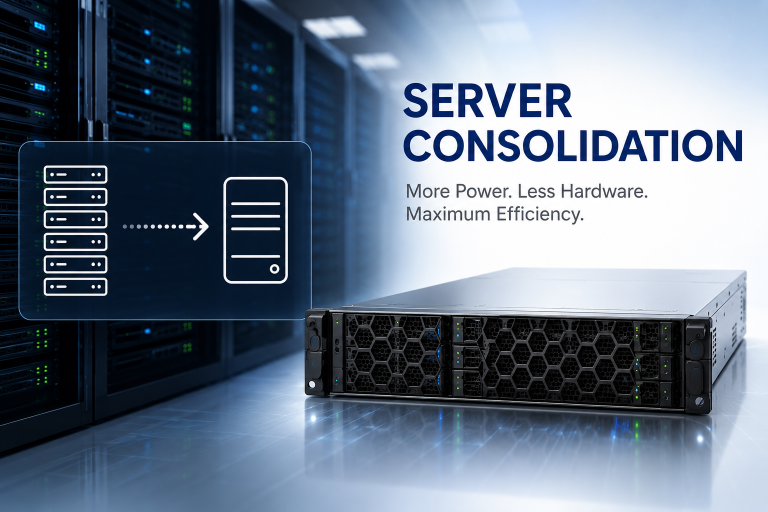

Choosing a server involves more than selecting processors, memory and storage. The physical form factor also affects installation, expansion, cooling, maintenance and the amount of space the infrastructure requires.
Tower, rack and blade servers can all support demanding business workloads, but they are designed for different operating environments.
A small office may benefit from the simplicity of a tower server, while a growing organisation may need the density and organisation of rack-mounted infrastructure. Blade systems can provide even greater consolidation, but they require a larger initial commitment and more specialised management.
Understanding these differences helps businesses avoid purchasing equipment that is either difficult to expand or unnecessarily complex.
What Is a Tower Server?
A tower server is built inside a standalone upright enclosure similar to a desktop computer case.
It does not require a server rack and can be installed in an office, equipment room or other secure location with suitable power and ventilation.
Tower servers are commonly used by:
- Small and medium-sized businesses
- Branch offices
- Professional practices
- Retail locations
- Organisations purchasing their first dedicated server
- Businesses with only one or two physical servers
A tower server can support file sharing, business applications, databases, backups, virtual machines and other everyday workloads.
Its main advantage is simplicity. The server can operate without additional rack infrastructure, making it easier to deploy in environments where space and technical facilities are limited.
Advantages of Tower Servers
Tower servers usually offer a lower entry cost than more densely packaged server platforms.
They can provide:
- Straightforward installation
- Quiet operation compared with some rack systems
- Space for internal drives and expansion cards
- Easier access to internal components
- No requirement for a dedicated server rack
- Good performance for small and medium workloads
Many tower models also allow memory, storage and network capacity to be expanded as the business grows.
For an organisation running a single server, a tower configuration may provide everything required without introducing the cost of rack cabinets, rail kits and additional cooling arrangements.
Limitations of Tower Servers
Tower servers become less practical as the number of systems increases.
Several tower units can occupy significant floor or shelf space, and their power, cabling and network connections may become difficult to organise.
Other limitations may include:
- Lower equipment density
- Less efficient cable management
- More difficult centralised maintenance
- Limited suitability for data centres
- Fewer options for very large deployments
- A less structured expansion path
A tower server may be appropriate for the current requirement but should also be evaluated against expected growth.
A business that expects to add several servers within a few years may benefit from adopting rack infrastructure earlier.
What Is a Rack Server?
A rack server is designed to be mounted horizontally inside a standard server rack.
Its height is measured in rack units, commonly written as U. A 1U server occupies one rack unit, while a 2U server occupies two.
Rack servers are widely used in:
- Business server rooms
- Data centres
- Colocation facilities
- Managed hosting environments
- Private cloud platforms
- Virtualisation clusters
- Growing multi-server environments
They are available in many configurations, from compact single-processor systems to powerful multi-processor platforms with extensive memory and storage.
Advantages of Rack Servers
Rack servers provide a structured and scalable way to organise infrastructure.
Their main benefits include:
- Efficient use of floor space
- Standardised installation
- Easier cable management
- Centralised power and networking
- Broad hardware and configuration choices
- Support for gradual expansion
- Suitability for data centres and colocation
A business can begin with one or two rack servers and add more equipment over time without changing the overall infrastructure model.
The same rack can also contain network switches, storage systems, backup appliances, power distribution units and other equipment.
Rack servers are therefore often the most flexible choice for organisations expecting their infrastructure to grow.
Limitations of Rack Servers
Rack-mounted equipment normally requires more supporting infrastructure than a tower server.
This may include:
- A suitable server rack
- Rail kits
- Power distribution
- Cooling
- Cable management
- Physical security
- Noise control
- Uninterruptible power supplies
Rack servers can generate substantial heat and noise, particularly when several systems are installed together.
They should not be placed in an ordinary office area without considering ventilation and employee comfort.
Although a rack server may appear competitively priced, the total deployment cost should include the surrounding environment.
What Is a Blade Server?
A blade server is a compact modular server that installs into a shared chassis or enclosure.
Instead of each server having completely separate power, cooling, networking and management components, multiple blade servers share resources provided by the chassis.
A blade environment typically includes:
- A blade chassis
- Multiple server blades
- Shared power supplies
- Shared cooling fans
- Network modules
- Storage or connectivity modules
- Centralised management tools
Blade servers are mainly used in larger organisations and data centres that require high computing density.
They can support virtualisation, private cloud platforms, large application environments and other workloads requiring many coordinated servers.
Advantages of Blade Servers
Blade systems are designed to consolidate substantial computing capacity into a smaller physical footprint.
They may provide:
- High server density
- Centralised hardware management
- Shared power and cooling
- Reduced cabling
- Faster deployment of additional server nodes
- Consistent configurations
- Efficient management of large environments
Adding a new server may be as simple as inserting another blade into the existing chassis, provided that capacity is available.
This can make blade systems attractive for organisations operating standardised clusters or large virtualised environments.
Limitations of Blade Servers
Blade infrastructure usually has a higher initial cost.
The business must invest in the chassis, connectivity modules and management platform before receiving the full benefit of the architecture.
Other considerations include:
- Greater platform complexity
- Dependence on a specific manufacturer ecosystem
- Chassis capacity limitations
- Concentrated power and cooling requirements
- Potentially expensive upgrades
- Reduced flexibility when mixing hardware generations
- A larger impact if shared chassis components fail
Blade servers are rarely the most economical option for a business that needs only one or two servers.
Their advantages become more relevant when enough blades are installed to justify the shared infrastructure.
Tower, Rack and Blade Server Comparison
| Consideration | Tower Server | Rack Server | Blade Server |
|---|---|---|---|
| Typical environment | Small office or branch | Server room or data centre | Data centre or large enterprise |
| Initial cost | Usually lowest | Moderate | Usually highest |
| Rack required | No | Yes | Yes, with dedicated chassis |
| Equipment density | Low | High | Very high |
| Expansion | Add separate servers | Add servers to available rack space | Add blades to chassis |
| Cabling | Separate for each server | Organised within rack | Shared through chassis |
| Management | Individual server management | Individual or centralised | Highly centralised |
| Cooling requirements | Moderate | Higher | High and concentrated |
| Best suited to | Small deployments | Growing infrastructure | Large standardised environments |
When a Tower Server Makes Sense
A tower server may be the right choice when:
- The business needs only one physical server
- No server rack is available
- The server will operate in a small office
- Noise must be kept relatively low
- Internal expansion capacity is important
- The budget is limited
- Infrastructure growth is expected to remain modest
Tower servers are often suitable for local file services, accounting systems, small databases, backup storage and basic virtualisation.
The server should still be placed in a secure and well-ventilated location. It should not be treated like an ordinary desktop computer simply because it uses a similar enclosure.
When a Rack Server Makes Sense
A rack server is often the most practical option when:
- The business already has a server room or rack
- Multiple servers are required
- Infrastructure will expand over time
- Structured cabling is important
- The equipment will be placed in colocation
- Virtualisation or clustering is planned
- Centralised power and network management are required
Rack servers provide a strong balance of flexibility, density and availability.
For many growing organisations, they offer a clearer long-term expansion path than tower systems without requiring the full commitment of blade infrastructure.
When a Blade Server Makes Sense
Blade servers may be appropriate when:
- The organisation operates many physical server nodes
- Computing density is a major priority
- Workloads use standardised server configurations
- Centralised deployment and management are important
- The data centre can support concentrated power and cooling
- The business has the technical expertise to manage the platform
- Long-term growth justifies the chassis investment
A blade platform should be evaluated as a complete infrastructure system rather than as a collection of individual servers.
The cost of the chassis, networking, licences, support and future expansion should all be included in the comparison.
Consider Space, Cooling and Noise
The server form factor changes how heat and noise are concentrated.
A single tower server may operate comfortably in a ventilated equipment room. Several rack servers can produce considerably more heat and may require dedicated cooling.
Blade systems place even more computing capacity into a small area, creating high power and cooling demands within the rack.
Before purchasing, confirm:
- Available rack or floor space
- Power capacity
- Cooling capacity
- Airflow direction
- Noise restrictions
- Physical security
- Backup power
- Fire protection
A powerful server is not reliable if the surrounding environment cannot support it.
Compare the Complete Deployment Cost
Hardware price alone does not show the full cost of each form factor.
For tower servers, include:
- Server hardware
- Power protection
- Secure placement
- Networking
- Future floor-space requirements
For rack servers, include:
- Rack cabinet
- Rails
- Power distribution
- Cooling
- Cabling
- Network switches
- Installation
For blade servers, include:
- Blade chassis
- Server blades
- Network modules
- Shared power supplies
- Management licences
- Support contracts
- Data centre power and cooling
A tower server may have the lowest initial cost, while a rack system may provide better long-term value as the environment expands.
A blade system may become cost-effective only when it is used at sufficient scale.
Think About Future Expansion
The best form factor should support the expected direction of the business.
Ask:
- How many servers are required today?
- How many may be required within three to five years?
- Will the systems remain on-site or move to colocation?
- Is a server rack already available?
- How much power and cooling capacity exists?
- Will the business use virtualisation or clustering?
- Who will manage the infrastructure?
- How quickly must additional capacity be deployed?
- Are standardised server configurations important?
- What is the total cost of the complete environment?
A form factor that appears suitable for the current workload may create unnecessary replacement or migration costs later.
Final Recommendation
Choose a tower server when the business needs a simple standalone system, has limited infrastructure and does not expect to operate many physical servers.
Choose a rack server when the organisation needs structured installation, easier expansion and a flexible platform for a growing server environment.
Choose a blade server when high computing density, standardisation and centralised management justify the additional cost and complexity of a shared chassis.
For many small businesses, a tower server is an effective starting point. For growing organisations and data-centre deployments, rack servers are usually the most adaptable option. Blade servers are best reserved for larger environments where their density and shared management provide measurable operational value.
Ila Express supplies tower, rack and blade server infrastructure configured around business workloads, storage requirements, expansion plans and operating environments.
Contact Ila Express to compare server form factors and identify the most suitable platform for your business.