
A network switch connects computers, servers, printers, wireless access points and other devices within a business network.
For a small office, purchasing a switch may initially appear simple: choose the required number of ports and an appropriate network speed.
However, buyers must also decide whether the switch should be managed or unmanaged and whether it needs Power over Ethernet, commonly known as PoE.
An unmanaged switch offers straightforward connectivity with little or no configuration. A managed switch provides greater control over traffic, security, monitoring and resilience. A PoE switch can also deliver electrical power through network cables to compatible devices.
The right choice depends on the size of the network, the importance of connected systems and how much control the business requires.
What Does a Network Switch Do?
A network switch connects devices on the same local network and directs traffic to the appropriate destination.
Typical connected equipment includes:
- Desktop computers
- Business laptops
- Servers
- Printers
- Wireless access points
- Internet Protocol phones
- Security cameras
- Network storage
- Building-management devices
- Other switches
Unlike a basic splitter, a switch learns which devices are connected to its ports and forwards traffic efficiently.
The switch may operate behind a router or firewall that connects the local network to the internet and other locations.
What Is an Unmanaged Switch?
An unmanaged switch is designed to work with little or no configuration.
The buyer normally connects power, attaches network cables and begins using it.
The switch automatically handles basic Ethernet communication without requiring an administrator to define settings.
Unmanaged switches are commonly used for:
- Small offices
- Meeting rooms
- Temporary workspaces
- Home offices
- Basic device expansion
- Simple networks with low security requirements
They are generally affordable and easy to install.
Advantages of Unmanaged Switches
An unmanaged switch can be appropriate when the network is small and straightforward.
Advantages include:
- Simple installation
- No specialist configuration
- Lower purchase price
- Minimal administration
- Compact models
- Broad device compatibility
For example, a small office may use an unmanaged switch to connect several computers, a printer and a network storage device.
If all equipment can remain on one network and advanced monitoring is unnecessary, a managed model may offer little immediate benefit.
Limitations of Unmanaged Switches
The simplicity of an unmanaged switch also creates limitations.
The business may be unable to configure:
- Virtual local area networks
- Traffic priorities
- Port-level security
- Network monitoring
- Link aggregation
- Redundant connections
- Bandwidth limits
- Remote administration
When a network problem occurs, an unmanaged switch may provide little information about which port or device is responsible.
This can make troubleshooting more difficult as the network grows.
What Is a Managed Switch?
A managed switch provides administrative control over how the network operates.
It normally includes a web interface, command-line interface or central management platform.
Administrators can configure individual ports, separate network traffic, monitor connected devices and apply security policies.
Managed switches are commonly used in:
- Medium and large offices
- Server rooms
- Multi-floor buildings
- Schools
- Hotels
- Retail sites
- Warehouses
- Networks with wireless access points
- Security-camera environments
- Voice-over-IP deployments
They are also useful in smaller organisations where security, reliability or future growth is important.
Advantages of Managed Switches
Managed switches can provide features such as:
- VLANs
- Quality of service
- Port monitoring
- Link aggregation
- Spanning Tree Protocol
- Access-control features
- Port disabling
- Traffic statistics
- Remote administration
- Firmware management
These capabilities allow the business to organise and protect the network rather than treating every connected device in the same way.
A managed switch can also help technical staff diagnose faults more quickly.
What Is a Smart or Web-Managed Switch?
Some switches sit between basic unmanaged models and fully managed enterprise switches.
They may be described as:
- Smart switches
- Web-managed switches
- Lightly managed switches
- Easy-managed switches
These models commonly provide a simplified set of features through a web interface.
They may support:
- VLANs
- Basic quality of service
- Link aggregation
- Port statistics
- Loop prevention
- PoE management
A smart switch can be a practical option for a small or medium-sized business that needs more control without the cost or complexity of a full enterprise platform.
The feature set varies considerably, so buyers should verify the exact capabilities rather than relying on the product description alone.
Why VLAN Support Matters
A virtual local area network, or VLAN, separates devices into logical network groups even when they connect to the same physical switch.
For example, a business may create separate VLANs for:
- Employees
- Guest Wi-Fi
- Security cameras
- Internet phones
- Servers
- Building systems
- Management devices
This separation can improve security and reduce unnecessary traffic.
Guest devices should not normally have the same access as internal computers. Security cameras may also need to communicate only with the recording system rather than the complete business network.
VLANs require compatible managed switches and appropriate router or firewall configuration.
Quality of Service
Quality of service, or QoS, allows important traffic to receive priority.
This can be useful for:
- Voice calls
- Video meetings
- Business applications
- Real-time communications
- Critical system traffic
For example, large file transfers could otherwise compete with internet-phone traffic and reduce call quality.
A managed switch can identify or prioritise certain traffic according to configured rules.
QoS cannot create additional bandwidth, but it can help use existing capacity more effectively during busy periods.
Network Monitoring
Managed switches can provide information about traffic and connected devices.
Administrators may be able to view:
- Port connection status
- Network speed
- Traffic volume
- Transmission errors
- PoE power use
- Device addresses
- Link failures
- Unusual activity
This visibility helps identify overloaded connections, faulty cables or devices generating excessive traffic.
Some switches can also send alerts or export information to a central monitoring system.
An unmanaged switch typically provides little more than physical indicator lights.
Port Security and Access Control
Managed switches may support controls that restrict how ports are used.
Possible features include:
- Limiting approved device addresses
- Disabling unused ports
- Requiring network authentication
- Restricting traffic between VLANs
- Detecting unauthorised network services
- Preventing certain loop conditions
These controls can reduce the risk of someone connecting an unauthorised device to an available network socket.
They should form part of a wider security approach that also includes firewalls, secure Wi-Fi, identity management and device protection.
Link Aggregation
Link aggregation combines two or more network connections into one logical link.
It may be used between:
- Switches
- Servers and switches
- Network storage and switches
- Switches and firewalls
Potential benefits include:
- More combined bandwidth
- Connection redundancy
- Better distribution of traffic
The connected devices must support compatible aggregation methods.
Link aggregation does not always make one individual transfer operate at the combined speed of every cable. Its main value often appears when several users or devices communicate simultaneously.
Loop Prevention
A network loop can occur when switches are connected in a way that allows traffic to circulate repeatedly.
This can create excessive traffic and make the network unusable.
Managed switches may support Spanning Tree Protocol or related technologies that detect redundant paths and block the appropriate connection until it is needed.
This is particularly important when:
- Several switches are connected
- Redundant links are used
- Network cabling is complex
- Users may connect ports incorrectly
Unmanaged switches may offer basic loop detection, but the capabilities and visibility are usually more limited.
What Is Power over Ethernet?
Power over Ethernet allows a network cable to carry both data and electrical power.
A PoE switch can power compatible devices without requiring a separate electrical socket beside each one.
Common PoE devices include:
- Wireless access points
- Internet Protocol cameras
- VoIP phones
- Door-access controllers
- Intercom systems
- Sensors
- Small network devices
This can simplify installation, especially when equipment is mounted on ceilings, walls or outdoor structures.
How PoE Simplifies Installation
Without PoE, a wireless access point or security camera may require:
- A network cable
- A nearby electrical socket
- A power adapter
- Additional electrical installation
With PoE, one Ethernet cable can provide both connectivity and power.
This can reduce cabling complexity and allow devices to be installed in more suitable locations.
It also centralises the power source in the network cabinet, which can make backup power and fault management easier.
When PoE Is Particularly Useful
PoE is valuable when deploying several devices across a building.
Typical examples include:
Wireless Access Points
Ceiling-mounted access points are often positioned where wireless coverage is best rather than where electrical sockets are available.
PoE allows them to receive power from the communications cabinet.
Security Cameras
Network cameras may be installed on walls, ceilings, entrances or external structures.
PoE reduces the need for separate power cabling at every camera location.
Internet Phones
A PoE switch can power desk phones directly through their network connections.
This can reduce the number of power adapters required around workstations.
Access-Control Systems
Door controllers, intercoms and related devices may use PoE where supported by the manufacturer.
This can simplify installation and centralise power management.
PoE Standards and Power Levels
PoE is available in several standards that provide different levels of electrical power.
Buyers may encounter terms such as:
- PoE
- PoE+
- PoE++
- IEEE 802.3af
- IEEE 802.3at
- IEEE 802.3bt
Higher-power standards support devices requiring more electricity.
A basic phone may need relatively little power, while an advanced wireless access point, pan-tilt-zoom camera or display may require substantially more.
The switch and connected device must support compatible standards.
The business should verify the device’s required power rather than assume that every PoE switch can operate it.
Understand the PoE Power Budget
A PoE switch has a total power budget shared across its ports.
For example, a switch may have enough capacity to power several low-consumption phones but not the maximum permitted load on every port simultaneously.
When planning, record:
- Number of PoE devices
- Maximum power required by each device
- Expected future devices
- Switch power budget
- Power available per port
- Required PoE standard
Allow reasonable spare capacity for device startup, replacements and expansion.
A switch with 24 PoE ports does not necessarily have enough electrical capacity to deliver maximum power to all 24 devices at once.
PoE and Backup Power
One advantage of centralised PoE is the ability to connect the switch to an uninterruptible power supply.
During a short electrical interruption, the UPS may keep operating:
- Wireless access points
- Internet phones
- Security cameras
- Door-access equipment
- Network connections
This can be more practical than placing separate backup-power devices beside every endpoint.
The UPS must be sized for the switch’s own power use plus its PoE load.
A heavily loaded PoE switch may require substantially more backup capacity than a standard non-PoE model.
PoE Does Not Remove Every Power Requirement
The PoE switch still needs reliable electrical power.
It may also need:
- Sufficient cooling
- Appropriate rack space
- A suitable UPS
- Redundant power supplies
- Correct circuit capacity
High-power PoE switches can generate more heat than ordinary switches.
The communications cabinet should provide adequate ventilation and should not be enclosed in an unsuitable uncooled space.
PoE Switch or PoE Injector?
A PoE injector adds power to one network cable between a standard switch and a compatible device.
Injectors can be useful when:
- Only one or two PoE devices are required
- The existing switch does not support PoE
- Replacing the switch is unnecessary
- A temporary installation is planned
A PoE switch is usually easier to manage when many powered devices are required.
It centralises power delivery and may allow administrators to view or restart individual PoE ports remotely.
Using numerous separate injectors can create cabling and power-adapter clutter.
Remote PoE Management
Managed PoE switches may allow administrators to:
- View power use by port
- Set port power limits
- Disable PoE on selected ports
- Restart a connected device
- Schedule power availability
- Prioritise important devices
Remote power cycling can be useful when a camera, phone or access point stops responding.
Instead of physically disconnecting the device, an administrator may be able to restart it from the switch interface.
This feature can reduce support effort in remote offices or difficult-to-access installations.
Port Count and Expansion
Buyers should choose a switch with enough ports for current devices and reasonable growth.
Common port counts include:
- 5 ports
- 8 ports
- 16 ports
- 24 ports
- 48 ports
Count every required connection, including:
- Computers
- Printers
- Access points
- Phones
- Cameras
- Servers
- Network storage
- Firewalls
- Other switches
- Management connections
Do not purchase a switch with exactly the number of ports currently required.
Keeping some ports available simplifies expansion and equipment replacement.
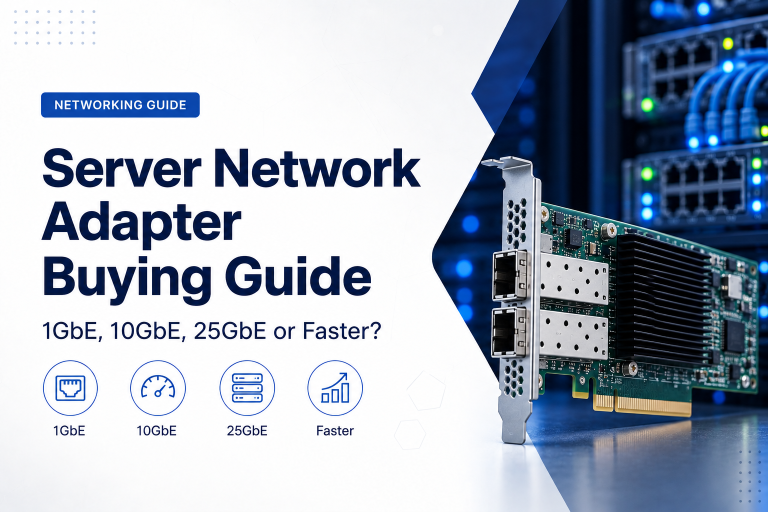
Network Speed
Common switch port speeds include:
- 100 megabits per second
- 1 gigabit per second
- 2.5 gigabits per second
- 5 gigabits per second
- 10 gigabits per second
Gigabit Ethernet remains suitable for many office devices.
Higher speeds may be useful for:
- Modern wireless access points
- Servers
- Network storage
- Video production
- Engineering workloads
- Switch uplinks
- High-density offices
The complete connection must support the selected speed, including the network adapters, cables and connected equipment.
A faster switch cannot increase performance when another component is limited to a lower speed.
Multi-Gigabit Ports and Wireless Access Points
Modern wireless access points can generate more than one gigabit per second of total traffic.
A switch with 2.5-gigabit or faster access ports may prevent the wired connection from becoming a bottleneck.
The access point may also require PoE+ or PoE++.
When selecting switches for a wireless upgrade, verify both:
- Network port speed
- PoE power requirement
Upgrading only one of these areas may limit the capability of the new access points.
Uplink Capacity
The uplink connects the switch to another switch, router, firewall or core network.
A 24-port gigabit switch may support many devices whose combined traffic exceeds one gigabit.
Depending on the workload, the business may need:
- Multiple aggregated uplinks
- 10-gigabit uplink ports
- Fibre connections
- Redundant uplinks
Not every office requires a high-speed uplink. Many user devices generate only modest average traffic.
However, servers, network storage, cameras and busy wireless networks can increase demand significantly.
Copper and Fibre Connections
Most desktop devices use copper Ethernet cabling.
Fibre may be appropriate for:
- Longer distances
- Connections between buildings
- High-speed uplinks
- Electrically noisy environments
- Core network links
- Greater isolation between facilities
Managed switches may include SFP or SFP+ slots for fibre or compatible copper transceivers.
The transceiver type and fibre specification must match the required distance and connected equipment.
Switch Stacking
Some managed switches support stacking, allowing several physical switches to operate as one logical unit.
Stacking can provide:
- Simplified management
- High-speed inter-switch connections
- Easier expansion
- Redundant paths
- Centralised configuration
It is useful in larger networks but may require compatible models, licences or dedicated stacking cables.
Small organisations may obtain sufficient results from ordinary managed switches connected through suitable uplinks.
Standalone or Centrally Managed Switches
Managed switches may be administered individually or through a central platform.
Centralised management can help when the business operates:
- Several switches
- Multiple offices
- Many access points
- Standardised network policies
- Remote sites
A central platform may provide:
- Configuration templates
- Firmware management
- Monitoring
- Inventory
- Alerts
- Remote troubleshooting
Confirm whether central management requires subscriptions, licences or permanent internet access.
Cloud-Managed Network Switches
A cloud-managed switch is administered through an online portal rather than only through a local interface.
This can make remote support easier.
Potential advantages include:
- Access from several locations
- Central monitoring
- Simplified configuration
- Remote firmware updates
- Shared management with wireless systems
Potential concerns include:
- Recurring licence fees
- Provider dependency
- Internet-management requirements
- Account security
- Reduced functionality after subscription expiry
Multi-factor authentication should be enabled for the management platform.
The business should also understand what happens if it later changes supplier or stops paying for the management service.
Security Updates and Product Support
Network switches contain firmware that may require security and stability updates.
Before purchasing, confirm:
- Manufacturer support period
- Firmware-update process
- Availability of security notices
- Warranty duration
- Replacement options
- Technical support
- Licence requirements
Very low-cost switches may receive limited long-term support.
For important business networks, lifecycle support can be more valuable than a small saving in the initial purchase price.
Fanless and Actively Cooled Switches
Small switches may use passive cooling and operate without fans.
Fanless switches are useful in:
- Quiet offices
- Meeting rooms
- Reception areas
- Small wall cabinets
Larger or higher-power PoE switches may require active cooling.
They can produce noticeable noise and heat.
Before installing a switch near employees, consider:
- Fan noise
- Airflow
- Cabinet ventilation
- Room temperature
- Dust
- PoE load
Server-room equipment may not be suitable for placement under a desk or in a quiet office.
Desktop, Wall-Mounted and Rack-Mounted Models
Switches are available in different physical designs.
A small desktop switch can be suitable for a few devices.
Larger business switches may be designed for:
- Wall cabinets
- Communications racks
- Server racks
Check:
- Physical dimensions
- Rack-mount hardware
- Power-connector location
- Ventilation direction
- Cable access
- Environmental requirements
The installation location should be secure and accessible for maintenance.
When an Unmanaged Switch Is Enough
An unmanaged switch may be appropriate when:
- The network is small
- All devices can share one network
- No advanced monitoring is required
- The installation is temporary
- The business has limited technical resources
- Downtime has modest impact
- The switch is used only for simple expansion
For a small office with a few computers and a printer, an unmanaged gigabit switch may provide everything required.
Select a reputable model with sufficient ports and suitable warranty coverage.
When a Managed Switch Is Worthwhile
A managed switch is usually appropriate when the business needs:
- Separate employee and guest networks
- Security-camera isolation
- VoIP prioritisation
- Network monitoring
- Redundant connections
- Remote administration
- Several connected switches
- Better troubleshooting
- Stronger access controls
- Future network growth
A managed model may also be sensible for a small business if the network supports critical applications or is maintained by an external IT provider.
The additional purchase cost can be justified by better visibility and control.
When PoE Is Worthwhile
Choose PoE when the network includes or is likely to include:
- Wireless access points
- IP cameras
- VoIP phones
- Door controllers
- Intercoms
- Compatible sensors
A small number of devices may be supported using injectors.
For several devices, a PoE switch usually provides a cleaner and more manageable installation.
Calculate the complete power budget and confirm the required PoE standard before purchasing.
Common Switch Buying Mistakes
Buying Too Few Ports
The switch has no capacity for access points, cameras or future employees.
Ignoring the PoE Power Budget
The switch has enough PoE ports but insufficient total power for every device.
Selecting an Unmanaged Switch for a Complex Network
The business later discovers it cannot create VLANs or diagnose traffic problems.
Buying Managed Features That No One Will Configure
A managed switch provides little benefit when it remains on default settings and is never monitored.
Forgetting Uplink Capacity
Many devices share one slow connection to the rest of the network.
Ignoring Heat and Noise
A high-power PoE switch is installed in an unsuitable office cabinet.
Failing to Plan Management Security
The switch uses a default password or an unprotected cloud-management account.
A Practical Network Switch Checklist
Before selecting a switch, ask:
- How many devices must connect today?
- How many additional ports may be needed?
- Is gigabit Ethernet sufficient?
- Are multi-gigabit ports required?
- What uplink speed is needed?
- Do employee, guest, camera or voice networks need separation?
- Is traffic monitoring required?
- Are redundant links needed?
- Will the switch be managed locally or centrally?
- Which devices require PoE?
- Which PoE standard does each device require?
- What is the total PoE power budget?
- Is a UPS required?
- Is adequate cooling available?
- Are fibre connections required?
- How long will firmware and technical support remain available?
- Who will configure and monitor the switch?
- Are management accounts protected with strong authentication?
These questions help determine whether an unmanaged, smart-managed or fully managed PoE switch is the appropriate choice.
Final Recommendation
Choose an unmanaged switch for a small, simple network that requires only reliable basic connectivity.
Choose a managed switch when the business needs VLANs, traffic prioritisation, monitoring, remote administration, stronger security or resilient connections.
Choose PoE when access points, cameras, phones or other compatible devices need both network connectivity and power. Confirm the required PoE standard and calculate the total power budget rather than counting only the number of ports.
The right switch should provide enough capacity for current equipment, practical room for growth and the level of management the organisation can use effectively.
Ila Express supplies unmanaged, smart-managed and fully managed network switches, including PoE, multi-gigabit and fibre-capable models for offices, server rooms and multi-site business networks.
Contact Ila Express to review your network requirements and select a switch with the right port count, speed, management features and PoE capacity.